
How to Furnish a New Orleans Shotgun Home (and Love Every Inch of It)
Updated: Oct 8, 2025

To furnish a New Orleans shotgun home, use fewer, scaled pieces and protect the front-to-back walkway. Anchor one deep sofa to a long wall, pick slim-arm chairs with visible legs, favor vertical storage over bulky casegoods, layer long runners, and treat fireplaces as focal points so the room stays open and livable.
Shotgun Homes Don’t Let You Fake It: Why Scale and Flow Matter
Shotgun homes don’t give you much room to fake it. Anyone who’s ever tried to force a bulky recliner into one knows—you either work with the house or you fight it every day. The rooms line up en suite, door after door, straight to the back. Sectionals actually do well here when you know where to tuck them. What doesn’t work? A five- or six-piece living room set—sofa, loveseat, matching chairs, plus tables. You see it happen when someone moves in fresh from a suburban build: they try to drop it all in the front parlor and suddenly can’t walk to the kitchen without turning sideways.
Fireplaces, TVs, and Family Debates: What Actually Works
Almost every room has a fireplace—and they’re rarely on exterior walls. Instead, they’re placed on interior walls, lined up like beads on a string. It’s one of the house’s prettiest architectural details. And yet, it’s the first thing modern buyers wrestle with: do you mount the TV on that brick over the mantel or leave it open for art? It’s the kind of question that splits families.

Where They Came From
These houses didn’t just pop up by accident. They came from Saint-Domingue, a French colony like Louisiana, layered with African craftsmanship. Creole builders loved a shotgun house—doors lined up from front to back, equal-sized rooms, fireplaces stacked like beads on a string. Back then, people didn’t call it “open concept.” They called it en suite—room to room, straight through. It’s the same phrase we use for connected bathrooms and bedrooms today.
Americans and the Nearly 7-by-10 Bonus Room
When the Americans came in after the Louisiana Purchase, they built their own homes—same 12-by-10 rooms, but with a hallway. A novelty at the time. It didn’t solve the space issue, but it satisfied the American notion of privacy. Modern renovations have taken that idea further, carving hallways into original Creole shotguns and cottages. What’s left behind is the trickiest room to furnish in New Orleans real estate: the nearly 7-by-10 bonus room. Not quite seven feet wide, so not a legal bedroom. Great for an office until you try fitting a desk, a chair, and a couch. Works for a nursery until you add a crib, a glider, and a changing table—you’re out of space before you’ve unpacked the toys.

The Closet Conundrum
And if you’re wondering why there aren’t closets in these houses? Those big, beautiful armoires you see weren’t built to hide hotel TVs. They were there to let clothes breathe in the swampy Gulf air so they wouldn’t rot. That’s why you won’t find many closets even in sprawling French Quarter estates. The solution today is wall-to-wall custom storage—sometimes built by fine millworkers, sometimes ordered off IKEA and dressed up with trim. Even the fanciest homes in the Quarter use them, but no one’s telling.
Furnishing With Flow in Mind
Shotgun homes were never meant to hold extra. They were meant to hold life moving straight through—porch to kitchen, door to door—without apology. Back then, people kept the doors open. You knew someone was home just by the sound of feet passing through. Today, most windows don’t even open. We’re not letting in that sticky August air. But you can still feel that same passage, that straight shot through the house.
Furnishing one right means understanding that. It’s not about filling the rooms; it’s about letting them work the way they were designed. Every piece of furniture has to earn its place without blocking that natural flow. Narrow end tables are your friends. Big-box coffee tables meant for open-plan houses are not. Get it wrong and you chop the place to bits. Get it right and the whole house feels intentional, connected—like it’s always known exactly how you’d live here.
Tips That Actually Work
Modern living hasn’t made these houses easier to furnish. Big-box stores sell sofas made for sprawling suburban dens. But there’s a way to do it—and it doesn’t mean abandoning comfort.
Choose fewer, stronger pieces—a deep sofa and one good armchair.
Pick recliners scaled for the room: slimmer arms, visible legs, nothing oversized.
Use vertical storage—bookcases, wall shelves, and built-ins that climb high.
An oversized sofa along one wall creates comfort without blocking doorways.
A bench under a front window adds seating that can slide into play when you need it.
Layer long rugs to stretch the room visually without chopping it up.
Shotgun Home FAQ: Real Questions We Get All the Time
Q1. Can a sectional work in a shotgun house? Yes—choose a smaller-scale sectional with slim arms and place it on the long wall so the walkway stays clear.
Q2. Where should the TV go with interior fireplaces? If you can, use a low console on a side wall. If you must mount over brick, keep it low and angle seating toward conversation, not just the screen. Or a mantel will do.
Q3. What size sofa fits best in the front parlor? Typically 72–84 inches long with 34–36 inch depth and visible legs. Bigger pieces overwhelm the room and block doors.
Q4. How do you use the narrow 7×10 carved-out room? Think built-ins: horizontal murphy bed, daybed with storage, a wall desk, or a nursery with a mini-crib and narrow glider. Freestanding sets won’t fit.
Q5. How do I add storage without closets? Go wall-to-wall wardrobes (custom or IKEA with trim), tall bookcases, and hooks/rails; avoid deep dressers that jut into the path.
Double Parlors and Endless Possibilities
Double parlors add another layer. In some houses, the front room was for music or receiving guests, and the second was for dining. In others, it’s a living room up front and a dining room just behind. Modern owners flip them constantly: music room to living room, dining room to office, front room to a play space. These houses flex as much as you need them to.
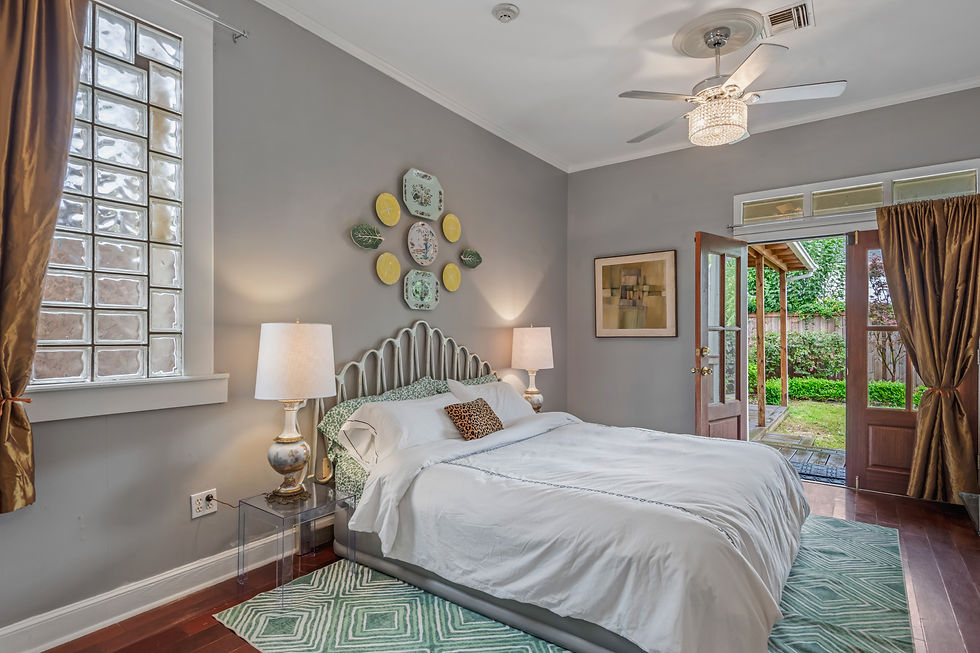
In my own house, the front room has been a music room, a workspace, a sitting area, and now it’s Cooper’s (our 10-month-old’s) play area. What used to be a costume room is now an office that doubles as a guest room, soon to be Cooper’s bedroom—and yes, it’s one of those nearly 7-by-10 carved-out rooms. These narrow walls run high with plenty of room for art you’d never have space for in a modern open concept.
Why They’re Gold
When you own a shotgun home, it changes as you change. And you make it work. It’s not about being perfect—it’s about being at home.
And here’s the truth: I still have Matt’s big plush recliner. It doesn’t work quite as well as I’d like in the space, but everyone fights over it anyway.
Love Shotgun Homes?
Did you know we currently have listed what may be New Orleans’ oldest all-brick shotgun home? Check out 708 Mandeville for details.
Think you’re not a shotgun person? Allow us to guide you through your next open house.
We’ll walk the floor plan, map the sofa, and point out easy storage wins—in 10 minutes. No pressure, just clarity.

Voted Neighborhood Favorite by Nextdoor three years in a row, Cool Murphy Real Estate is a top-producing, licensed real estate team based in New Orleans, brokered by Cool Murphy, LLC.
Celebrated for her next-level creative approach to real estate, Elisa Cool Murphy is an award-winning, top-performing real estate broker in New Orleans and the founder of Cool Murphy Real Estate.
Contact Her -
email: cool@coolmurphy.com
Facebook: @homeinneworleans
IG: @coolmurphynola
YouTube: @coolmurphynola
phone: 504-321-3194


Comments