
Selling the Middle Sister
A Prepped to Sell Case Story

Most sellers are asking the same three questions right now:
Will my house sell?
Will it sell quickly?
Will it sell at or close to what we're asking?
723 Esplanade answered all three.
Over the past year, 29 homes priced above $1 million came to market in the Marigny.
Only four sold.
723 Esplanade was one of them.
But that's not all.
It reached contract 44 days faster than the average successful million-dollar sale.
Closed at 98% of its original asking price. While the other successful sales in this group accepted far larger price reductions before reaching the finish line.
Those results weren't luck. They were the outcome of a deliberate strategy built around understanding how a home lives at its highest and best use, then making that story visible to the right buyer.

A House the Seller Thought Wouldn't Sell
"It's not going to sell."
That's exactly what the seller told me.
He wasn't looking for reassurance. He'd already spent six months getting reports of buyers who would walk through the house and walk right back out again.
The house had been on the market from spring through fall of 2025 before the seller was refered to our brokerage. People admired it. They appreciated it. They talked about it.
Then they left.
When we were introduced to the address of the home, I understood exactly why he felt that way.
What I couldn't understand was why buyers weren't connecting.
After all, this wasn't an ordinary house. Built in 1873, 723 Esplanade is the middle of three sister houses commissioned by Aristide Hopkins. More than 150 years later, she still holds a remarkable amount of what made her special in the first place, including a ballroom stretching across the rear of the home.
The first time I walked through it, however, the overwhelming feeling wasn't grandeur. It was tired. Functional. Dark.
It felt sad. Misunderstood. To put it plainly, she felt lonely.
The house had spent years surviving the hosting of loads of extended family, attempts at long-term renting, and more or less being presented as what it could do rather than what it was.
Could generate income? Yes.
Could it be divided? Sure. The sisters flanking her were already turned condo.
Could be adapted? Of course.
All true.
But none of it felt like the point. Because none of it really represented the highest and best use of the property.
What We Saw That Others Missed
The house had spent six months being marketed for what it could do, how it could earn money, what it could be.
We became interested in what it was.
723 Esplanade is the middle of three sister houses built in 1873. Over the years, the sisters drifted apart. The homes beside her eventually became condominiums. She lost her gallery somewhere along the way. Different owners left behind different chapters. Different generations solved different problems.
What struck me wasn't what had changed. It was what hadn't.
The proportions were still there.
The sense that this house had been built for gathering was still there.
The ballroom was still there. An actual ballroom! And that's what made it special.
A historic intact townhome, on "The (original) Avenue," with an intact ballroom spilling out to a private courtyard?! Are you kidding me? This was gold. But it was currently presented as an awkward living room.
723 Esplanade prior to Prepped to Sell
The more time I spent inside, the more convinced I became that she didn't need to become something new. Her 1870s Creole heiress bones corseted her proud and upright to this day.
But what would life look like for the heiress if she were born in 2026? How would she live life in New Orleans on Esplanade today?
The seller trusted us enough to let us try. Not with a major renovation. It wasn't necessary or warranted.
With roughly twenty thousand dollars to spend across more than 3,500 square feet and two stories. How? We shared a belief that there was a better way to introduce the house to the world. And the seller got on board with us.
So we started paying real attention.
No, not running comps. We did that naturally. But we did so much more.
We spent time in the city's notarial archives. We revisited the history. We looked at architecture books. We studied the market's recent million-dollar-plus buyers. We thought about who would be drawn to a house like this and what they would need to see in order to recognize it.
Then we got to work.
Walls were repaired. Rooms were painted. Furniture was moved out. Landscaping was refreshed. The front door was painted. The house was edited. Not reinvented. Edited.
The goal wasn't to change the story, but to make it easier to read. More palatable. More exciting. And as we worked, we documented the process, and people started talking.
Former owners appeared. Neighbors shared memories.
The result?
More stories surfaced.
The Ceiling Above the Chickens
One of those conversations centered on the kitchen.
The kitchen was the one room we couldn't solve with our budget. And there were two.
This part of the story is about the downstairs kitchen, and to understand that, you need to understand homes built in the 1800s in New Orleans.
Most were born into this world without kitchens. True story.
Ever wonder why kitchens and baths are usually the first things to date a historic home? When you get this far back into homebuilding, they were originally outside of the home.
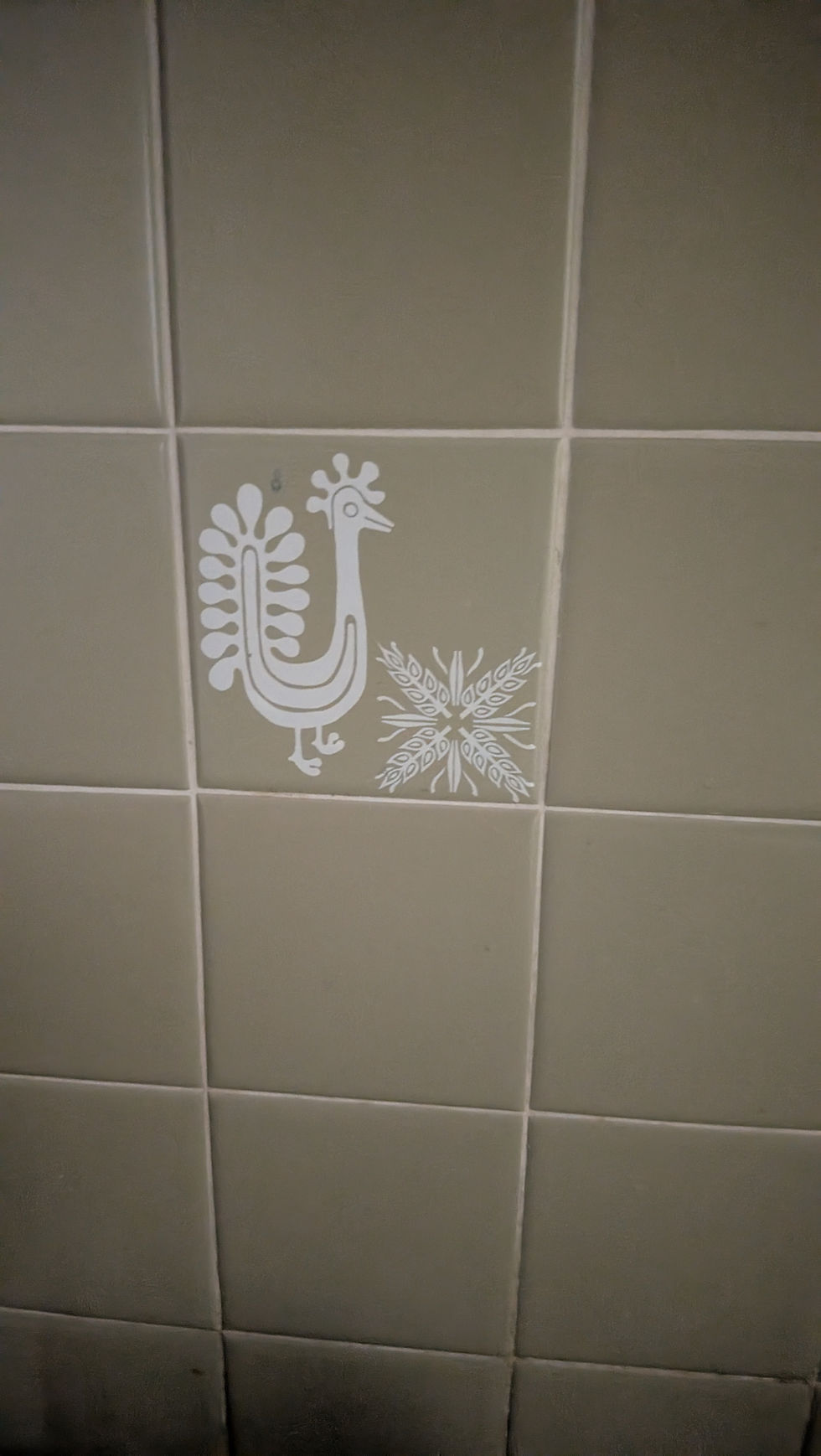
This kitchen represented two different eras. Part of it dated to the 1960s. Sage green tile. Little white chickens worked into the pattern. I always liked the chickens. They felt honest.
Later, around 2010, another kitchen had been added into what had once been a porch and then a sunroom. Cherrywood cabinets. Busy granite countertops. The two created a strange dual-kitchen dogleg layout.
The result was functional. It was also confusing.
If I'd had another fifty thousand dollars to spend, I probably would have spent it there.
Instead, we left it alone. And because we left it alone, we learned something we otherwise wouldn't have.
A former owner came through the house and shared a detail none of us knew.
Above those chicken tiles, the ceiling doesn't stop where it appears to. It rises. Possibly all the way to the height of the ballroom. More than that, original fixtures may still be there. Leaded-glass chandeliers. The original volume may still be there. Plaster and millwork may be there, too.
An entire layer of the house may still be waiting for later work.
The ceiling above the chickens.
Suddenly, the room felt different.
Easier to understand somehow.
Less complicated and full of possibility.
By then, it had become clear that people didn't need help seeing the house.
They needed help seeing themselves inside it.

Bringing the House Back to Life
That's when the idea for the ball arrived.
Not as a marketing event. That's too one-note. But as an answer. No, a way to help people experience our 1873 heiress hosting a gathering in 2026.
The house wasn't asking for another photoshoot. It didn't need another drone. It wasn't about another open house. It was asking to be used.
The brief became simple:
If that Creole heiress from 1873 found herself living at 723 Esplanade in 2026, what would she do on a cool winter evening... when she owned a ball room...
Simple. She'd throw a damn ball.
She would invite people over. She would gather friends. She would create an occasion. She'd demand the propper attire be worn. And, she'd very likely do something incredibly on trend.
So that's exactly what we did. And we did it Bridgerton style because, of course, we did.
And it was glorious.
The Merry Antoinettes joined us.
A solo cellist played contemporary music in a classical style.
Champagne circulated.
Canapaes dangled from white glittered trees.
The ballroom filled.
The courtyard glowed.
More than fifty people came through the house that evening.
For months, the house had sat mostly quiet while strangers passed through, imagining what they might do to it. For one evening, it got to be itself. It got a housewarming before the sale. Before the offer. And it needed it.
The ballroom did what it was built to do. People stayed past party time. Conversations unfolded. I announced my new book. Laughter bounced off walls that had spent too much time listening to silence. Mini photoshoots were held between friends. Customized winter cakes and cookies twinkled between hands and teeth.
The house stopped feeling lonely.
We captured the evening and shared it online.
That one reel, on one platform alone, reached nearly eighteen hundred people, most of whom had never followed our company before. Higher than the total number of views of the property on Zillow at that point.

The Woman in the Marigny
Among them was a woman living a few blocks away in the Marigny.
She wasn't at the event. She was scrolling through Instagram when she came across a party she hadn't attended.
A woman in a Rococo dress moves through the hallway. Doors opening. Men bowing. Women dancing in circles. A toddler in a pirate suit. String music is playing. Chandeliers glowing. Guests gathering. A house alive.
She watched it. Then she watched it again. Again. And then she sent a message.
She needed to see the house.
It took one showing.
The ballroom made sense. The mural made sense. The courtyard made sense. The ballroom made sense. Her future in that ballroom made sense.
Even the kitchen started making sense. Sort of.
Primary, ballroom, and courtyard after Prepped to Sell process.
The Room That Nearly Changed Everything
Which turned out to matter.
Because after inspections, standing in that room with the buyer, her contractor, her agent, Craig, and me, we found ourselves back in the one place that still required imagination. Surrounded by mid-century chickens, one challenge remained: how to make the kitchen work.
I had the answer. Not because I'm an interior designer. But because I had done the research. Keep two kitchens and freshen them up! One scullery kitchen. One entertaining kitchen.
A place for preparation and a place for gathering. One for messy dishes and wine boxes. One for passed canapes and gossip.
The old sunroom becoming part of the experience. Windows opening to the ballroom. Handsome caterers in bow ties. Food passed through. Silver cocktail mixers sloshing shaken martinis framed in 8 over 8 hung windows. Family gathered one night. Friends gathered the next.
The contractor could see a path forward. The buyer could see herself there. The conversation changed. The deal moved forward. And eventually so did everything else.
More images of the home Prepped to Sell.
The Closing Table
The house closed. The keys changed hands. The signs came down. The websites updated. All while, the reel kept dancing around Instagram.
The chickens stayed, for now. The ceiling remained unopened.
At closing, the seller thanked us. Then he laughed and said that the next house he bought, he was having us design it too.
I'll take that as a compliment.
The Answer to the Three Questions
Looking back, I don't think any single thing sold this house.
Not the ball, the reel, the repair, the mural by the stairs, the research, the hidden discoveries.
What sold the house was understanding it well enough to know what belonged, what didn't, and what it was asking for next.
Somewhere between the ballroom, the courtyard, and the ceiling above the chickens, the Middle Sister found her next steward.
Would it sell? Yes. Quickly? Absolutely. Close to ask? You betcha.
The answer to those three questions turned out to be YES in capital letters.
The more important question was whether the house could be understood. And who would it take to understand her and translate her best.
Want to get inside our approach? I wrote the book on that, and you can find your copy here.

Celebrated for her next-level creative approach to real estate, Elisa Cool Murphy is the author of Prepped to Sell: What Works Even When the Market Doesn't. She is an award-winning, top-performing real estate broker in New Orleans and the founder and owner of Cool Murphy Real Estate.
Contact Her -
email: cool@coolmurphy.com
Facebook: @homeinneworleans
IG: @coolmurphynola
YouTube: @coolmurphynola
phone: 504-321-3194


Comments